Just a few more updates.
 The Cedar Rapids Hamfest is Sunday. I will be on the lookout for a nice 2m Yagi to use on SSB. Tomorrow I will be working on tower grounding.

Just a few more updates.
The Cedar Rapids Hamfest is Sunday. I will be on the lookout for a nice 2m Yagi to use on SSB. Tomorrow I will be working on tower grounding.
Some photos this time around.
To build a tower you have to dig a hole. A pretty good sized one. In my case a minimum of 30" square and 48 inches deep. No problem. In normal soil.
I don't live on "normal soil". Our neighborhood is notorious for limestone. Even the electric utility had issues bringing in power due to all the rock in the ground. There's rumors that basements were dug with the help of dynamite. I don't know about that, but what I do know is that I ran into my fair share of limestone. It starts about 6" below the topsoil. And it stops, well, I don't know where it stops. I can't dig that far. But I'm guessing it goes down a long ways since there is a quarry about 1/4 mile east of us.
Needless to say it took me awhile to dig that hole. And in the end I rented a jack hammer to help me get through all that rock.
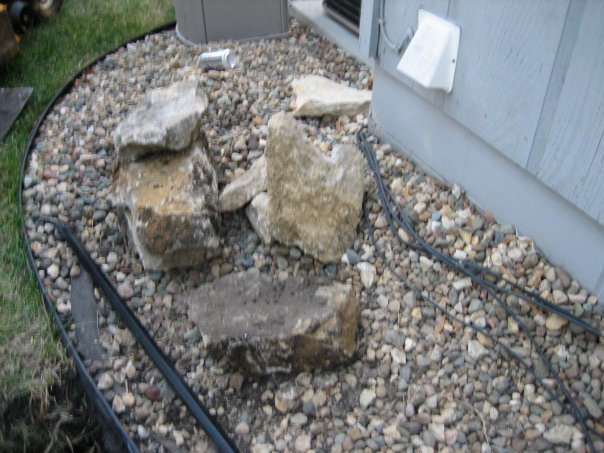
Just a few of the rocks I dug out.
I ended up making it to 48". I originally wanted to go 60" pretty badly, but after all that rock I'd had enough. That and finding a place to get rid of all that rock.
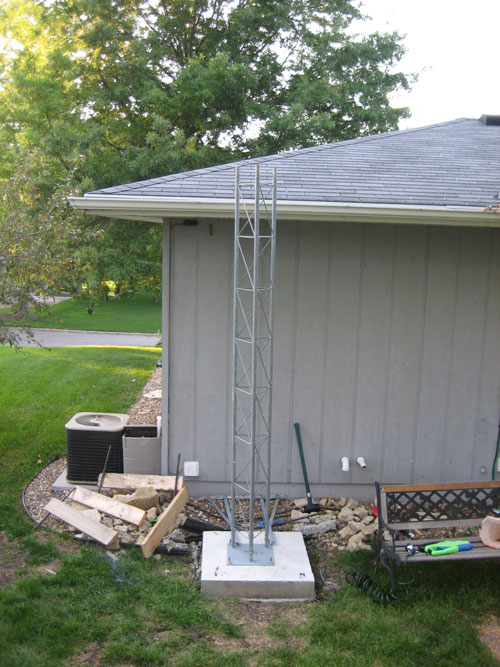
The Rohn tower book says that the concrete base should be 6" above grade. Or maybe it says 4" above grade. I don't really remember. Many hams leave the concrete several inches below grade, their thought process being that when they take the tower down they can just dump some soil there and plant grass. Good in theory. My concern was water, more specifically, rust. I don't like rusty towers. By keeping the base above grade I'm hoping to avoid any rust on the base of the tower.
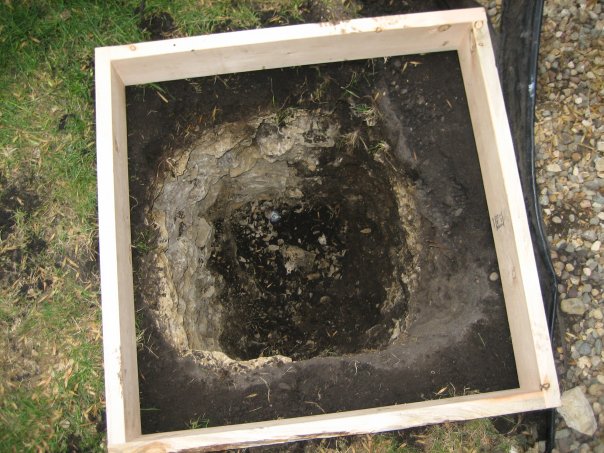
So here's the hole, and a 2×6 form to square it up.
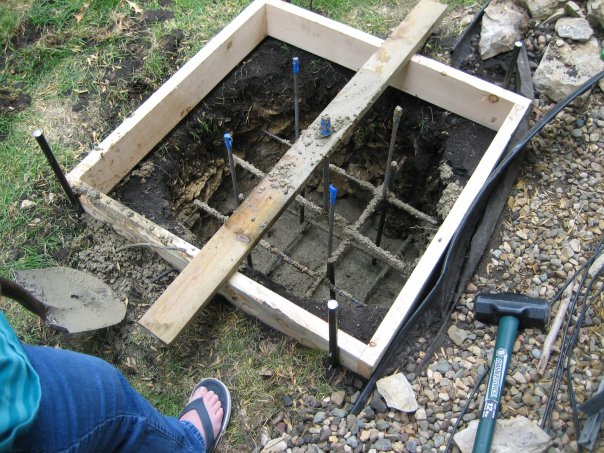
We added a welded rebar cage, and the J-bolts for the base plate. And of course, the concrete.
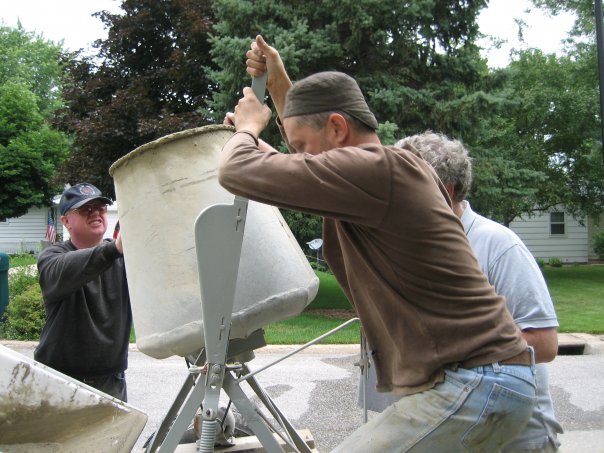
Robert (I didn't catch his call), Jay (KC0AKJ), and Cliffy (KC0RFN) mixed concrete.
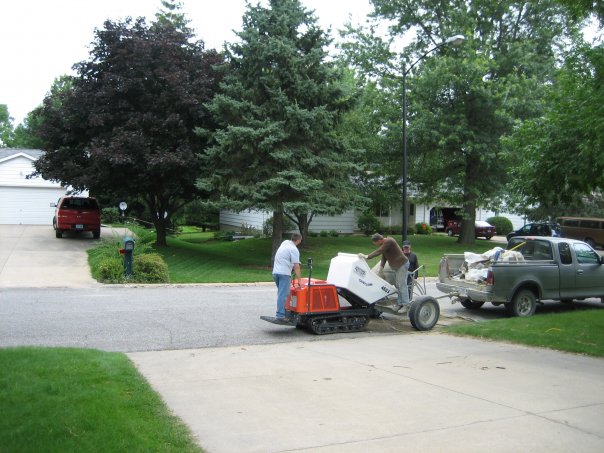
I had the easy job, driving the concrete buggy! Best $75 ever spent. Pushing wheelbarrows of concrete uphill would not have been fun.

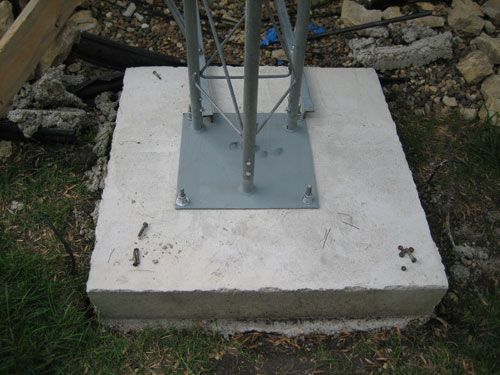
And here we are, 3500 pounds of concrete mix later.
I'm a bit slow at getting the pictures posted, it's been nearly two weeks since these were taken, so I'm a little bit further along than this. More to come.
I was never really happy with the original site, and I decided that the "Holy Cow" theme would be fun, so I made a few changes. I think I like it here much better now.
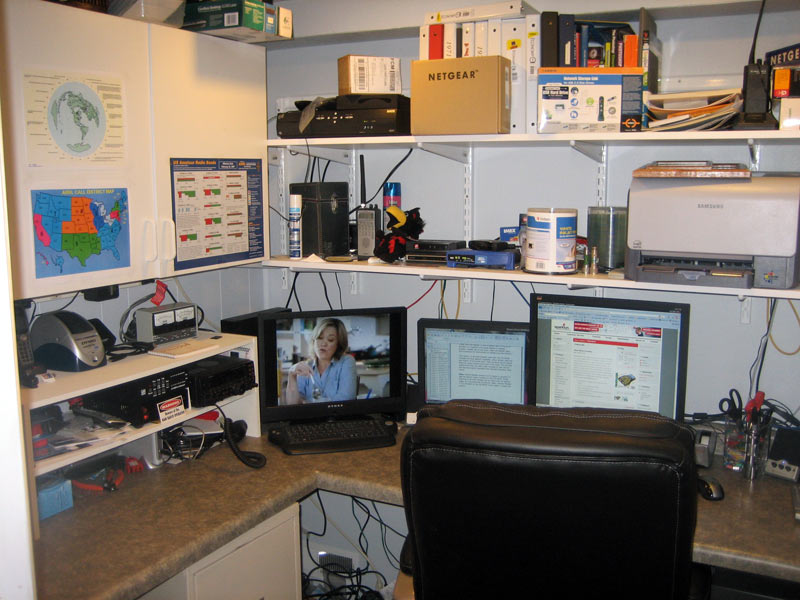
I just realized that there are no pictures of the shack on the site. The shack is very small. We don’t have much usable space in the basement, so it was a challenge to set up an area for radios. It was decided to carve out an area just over 6′ by 6′ in one corner. I built a couple of walls, installed a new ceiling, new carpet, and plenty of electrical. I squeezed in kitchen countertops on two walls, installed some shelving, and utilized 5′ of wall cabinets that were already there. It’s not much space, but it seems to work out pretty well.
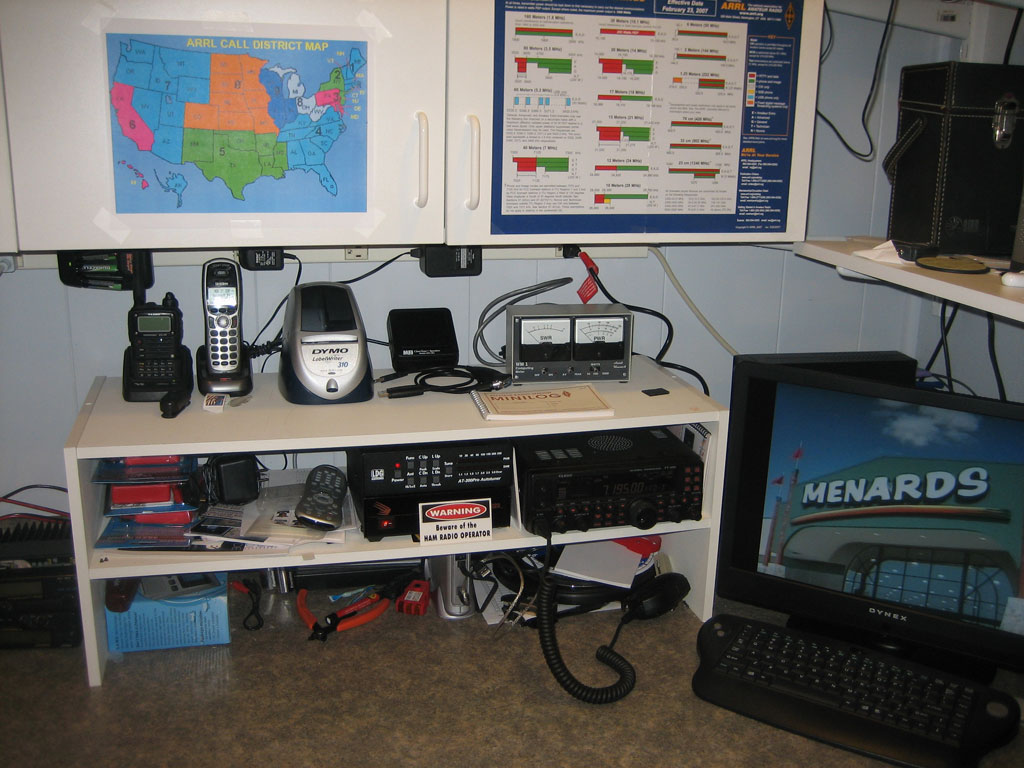
The biggest problem is keeping it clean.
My other “shack” is in my Blazer. There I have a Yaesu FT-7800 Dual Band, and a Radio Shack HTX-10 10m all-mode mobile. Working 10m mobile is a lot of fun.
Here is the latest on the new tower. So far I have acquired:
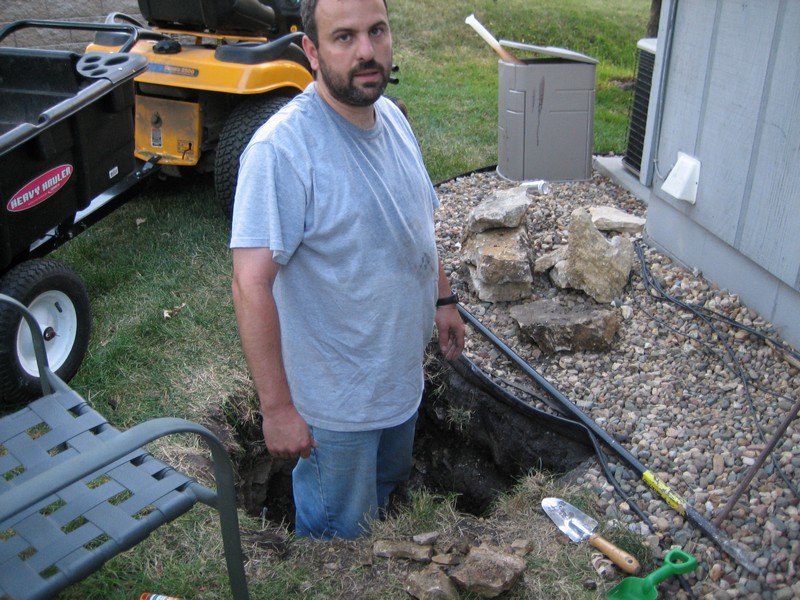
And so the digging of the foundation has begun. And it's been an uphill battle due to the property being situated on top of solid limestone.
The foundation will be approx 30 inches square, and four to five feet deep, depending on how hard it is to dig the rock once I hit the 4 foot level. You can see behind me next to the house some of the big chunks of rock that I've broken up and pulled out of the hole. Good times. Most of the rock is breaking into baseball sized pieces. There was about six inches of top soil over the rock. This may explain why my lawn dries out so quickly in the summer.
This past weekend I visited KA0ZOZ and acquired a used Cushcraft A3 tri-band beam, a Yaesu G-800SA rotor with 60+ feet of rotor cable, and a Kenwood TS-711A 2m all-mode radio. This has me even more fired up to get the hole dug! I still need to find a 2m yagi to use for SSB, and a bunch of coax. I'm thinking the Cedar Rapids Hamfest next month will be a good place to look.
I have a feeling the worst may be yet to come. I need to find a way to drive a few more ground rods, and trench in some wire between them and the single point ground bus bar at the coax entrance. I also plan to utilize a 'ufer' ground by having the rebar welded into a cage and bonding it to the tower legs.
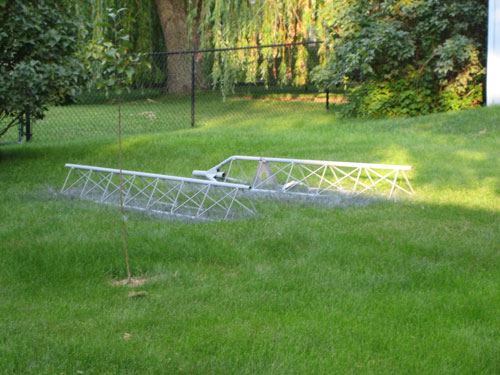
I now have three 10 foot sections of Rohn 25G tower sitting in my yard. I hope to get started soon getting that thing up in the air.
I still need a 36″ house bracket. Rohn gets $249.00 plus freight for their heavy duty “universal” model which supports both Rohn 25 and 45 (more on that to come). I think I’ll check to see if the local welding shop can make me one. Of course Rohn leaves most of the dimension out of their engineering drawings, but maybe they can figure it out.
Last fall I decided that I would like to start construction of a small tower in spring ’09. I wasn’t sure how many hoops the city would make me jump through, so I got started on that process nice and early.
And I’m glad I did. Turns out there is a height limit on “structures” in the City of Independence of 30 feet or two stories. An antenna, even a roof mounted one, is considered a “structure”. They told me my only hope of erecting a tower was to go before the board of adjustment, and that required paying a fee of $100 just to get them to meet. I tried to explain PRB-1 to the city building official, but he would have none of that.
So I went home, feeling somewhat defeated, but certainly not ready to give up. And not ready to pay $100 either.
It is interesting to note at this point that not only does PRB-1 say that a ham radio operator can build a tower, but there are other rules that could kick in here as well.
As directed by Congress in Section 207 of the Telecommunications Act of 1996, the Federal Communications Commission adopted the Over-the-Air Reception Devices (OTARD) rule concerning governmental and nongovernmental restrictions on viewers’ ability to receive video programming signals from direct broadcast satellites (“DBS”), broadband radio service providers (formerly multichannel multipoint distribution service or MMDS), and television broadcast stations (“TVBS”).
The rule (47 C.F.R. Section 1.4000) has been in effect since October 1996, and it prohibits restrictions that impair the installation, maintenance or use of antennas used to receive video programming. The rule applies to video antennas including direct-to-home satellite dishes that are less than one meter (39.37″) in diameter (or of any size in Alaska), TV antennas, and wireless cable antennas. The rule prohibits most restrictions that: (1) unreasonably delay or prevent installation, maintenance or use; (2) unreasonably increase the cost of installation, maintenance or use; or (3) preclude reception of an acceptable quality signal.
I’m having great difficulty receiving Direct Broadcast Satellite programming from the 129W location due to a tree on my neighbors property, this prevents reception of Cedar Rapids HD locals via Dish Network, my multi-channel provider. I also cannot recieve KIIN-DT, and since that station is technically in the Nielson market serving Independence I would be allowed to install a TV antenna to receive it. Never mind that I can receive KRIN-DT just fine.
So I put together a large packet of information that included a copy PRB-1, the FCC OTARD Fact Sheet, and some background information on Amateur Radio, including a list of local, state, and federal agencies that are served by Hams. I sent these packets to the city council person for my ward, the at-large council person, the city building inspector, the city manager, the mayor, and the city attorney.
On December 1, 2008, I received a letter from the City of Independence giving me permission to install an amateur radio antenna tower in my yard. However, they still require me to obtain a building permit first. I have a sneaking suspicion that they still have something up their sleeve.
More on this subject to come.
Yesterday I decided to play radio a little bit during the daytime. I heard a lot of European DX on 20m and managed to snag Belgium and Ireland. A station in Italy was coming in at 20 over S9, but he went QRT before I could make contact. It was fun.
After that I looked at a 56′ BX tower here in town. It comes complete with a nice HF beam and Ham IV rotor. Once I get a few other things out of the way and know where I stand with my income tax return I’ll make an offer on it.